

By Tochukwu Cyril
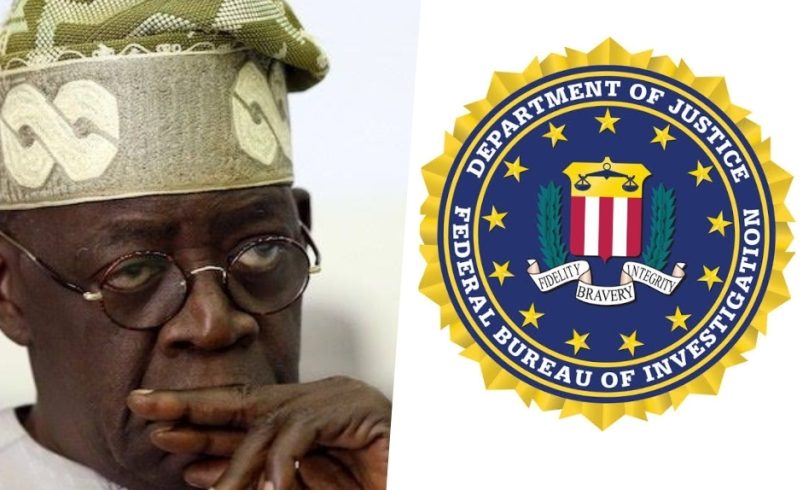
Just recently, the clamour for the Federal Bureau of Investigation (FBI) to reopen or release alleged case files concerning President Bola Ahmed Tinubu began trending again, with political actors and supporters within opposition circles appearing to embrace the issue as another strategy ahead of the 2027 presidential election.

But let us face reality.
Any presidential candidate who believes that relentlessly dragging President Bola Ahmed Tinubu into an alleged drug case in the United States is the strategy that will deliver the presidency in 2027 may be spending precious political capital on the wrong battle.

The allegations surrounding the President’s past have been debated extensively in Nigeria and abroad. They have featured prominently in political conversations and campaigns. Yet, despite the controversy, Tinubu became president.
The question opposition candidates should therefore ask themselves is simple: if this issue did not prevent him from winning the presidency in 2023, why should they assume it will suddenly become the magic bullet against an incumbent in 2027?
Tinubu is no longer a presidential candidate seeking to convince Nigerians that he is qualified to govern. He is the sitting President of the Federal Republic of Nigeria.
That reality changes the political equation.
There are also diplomatic and legal considerations surrounding any attempt to pressure a foreign government into taking action against a sitting head of state. The United States is not likely to make decisions about such matters simply because a Nigerian political group submits a petition or launches a campaign.
Those who are building their 2027 strategy around an expectation that the FBI will somehow intervene in Nigeria’s domestic political contest may therefore be setting themselves up for disappointment.
More importantly, what exactly happens if the FBI does nothing?
What is Plan B?
That is the question opposition presidential aspirants should be answering.
Presidential elections are not won by successfully tarnishing an opponent’s image. They are won by convincing millions of voters that you deserve their votes.
You may like:
FERMA: Where Is the Watchdog of Nigeria’s Federal Roads?
The opposition should be talking to Nigerians about the economy, jobs, insecurity, education, healthcare, infrastructure, electricity, food prices, poverty and the future of the Nigerian youth.
Tell Nigerians what you will do differently.
Present a credible manifesto.
Explain how you intend to finance your promises.
Show the electorate the people who will work with you.
Build your structures.
Go into the communities.
Listen to the people.
Then ask for their votes.
That is politics.
There is nothing wrong with scrutinising a candidate’s record or holding public officials accountable. Indeed, accountability is a fundamental part of democracy. But there is a difference between legitimate scrutiny and making an old allegation the centrepiece of an entire presidential campaign.
The latter risks turning a serious election into a referendum on personalities rather than policies.
There is another dimension that opposition politicians should consider carefully.
When Nigerian political actors repeatedly invite foreign institutions to investigate or publicly condemn allegations against Nigeria’s sitting president, they may believe they are damaging one individual. But the consequences can extend beyond the individual.
Nigeria already carries significant reputational challenges internationally. Deliberately projecting another narrative of presidential involvement in serious criminal allegations can reinforce negative perceptions about the country itself.
Political opponents may see this as an effective weapon against Tinubu. But Nigeria’s international image is bigger than one election and bigger than one administration.
The opposition should therefore be careful about the kind of message it sends to the outside world.
Ultimately, the FBI cannot campaign for you.
Neither can a petition.
Neither can an allegation.
Neither can social media outrage.
At the end of the day, the ballot box remains the great equaliser.
A candidate may generate millions of reactions online and still struggle to mobilise voters at the polling unit. Emotional support can create noise, but noise does not automatically become votes.
This is where the opposition needs to return to reality.
Read also:
It Is Too Early to Think Merger
The question is not who can generate the biggest controversy around Tinubu. The question is who can convince Nigerians that there is a better alternative?
Who has the structure?
Who has the message?
Who has the grassroots network?
Who has the credibility?
Who can mobilise voters across the country?
And most importantly, who can offer Nigerians a compelling reason to vote for them?
Those are the questions that should keep presidential aspirants awake at night.
The 2027 election will not be decided by the FBI. It will not be decided by petitions. It will not be decided by trending hashtags.
It will be decided by Nigerians standing behind the ballot box and choosing their preferred candidate.
So, to the opposition: stop looking for the FBI to win the election for you.
Go to the field.
Build your structures.
Sell your manifesto.
Convince the electorate.
Earn their trust.
And win their votes.
That is how presidential elections are won.
Follow BwariTimes for public opinions, political views, updates, news and insightful information in Bwari, FCT and Nigeria. Contact us for news coverage or for inquiries, we also live on all social media handles.