
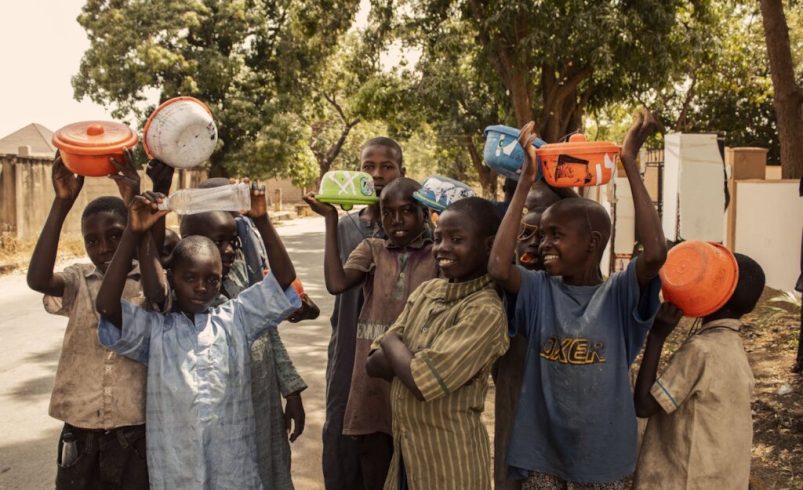

The increasing number of Almajiri children in Bwari Town and surrounding communities has become impossible to ignore. Every day, more young boys can be seen roaming the streets, begging at junctions, or surviving through odd jobs. Their growing presence has raised important questions that deserve honest and responsible public discussion.

This is not an attack on any religion or ethnic group. Rather, it is a call for the protection of children, the preservation of public order, and the enforcement of laws that safeguard the rights of every Nigerian child.
Did you lknow that Almajiri Commission exists? Discover more about their activities on their official website.
The first question is simple: where are these children coming from?

Many of these boys appear to be between six and eleven years old. They are far from home, often without parents or guardians, and depend on strangers for food and survival. Who transports them to Bwari? Who receives them? Under what arrangements do they leave their communities? Are government agencies monitoring this movement?
These are legitimate questions that deserve answers.
The Almajiri System and Islam
There is a common misconception that Islam requires parents to send their young sons away from home to fend for themselves. However, Islamic scholars have repeatedly explained that while seeking Islamic knowledge is highly encouraged, abandoning children to survive on the streets is not an Islamic obligation.
The Qur’an repeatedly places the responsibility of caring for children on parents.
Allah says:
“Mothers may breastfeed their children for two complete years… and upon the father is the mothers’ provision and their clothing according to what is acceptable.”
Qur’an 2:233
This verse establishes that fathers bear responsibility for the maintenance and welfare of their children.
The Qur’an also warns parents against neglect arising from poverty:
“Do not kill your children for fear of poverty. We provide for them and for you.”
Qur’an 17:31
Likewise:
“Do not kill your children because of poverty. We provide for you and for them.”
Qur’an 6:151
These verses affirm the sanctity of children’s lives and remind parents that financial hardship is never a justification for abandoning their responsibilities.
The Prophet Muhammad (peace be upon him) also emphasized parental responsibility. He said:
“Each of you is a shepherd, and each of you is responsible for his flock.”
(Sahih al-Bukhari and Sahih Muslim)
This teaching reinforces the principle that parents are accountable for the upbringing, safety, and wellbeing of their children.
It is also worth noting that millions of Muslim families across Nigeria and around the world raise their children at home while providing both Islamic and Western education. Many respected Muslim professionals, business owners, scholars, governors, legislators, judges, and public servants did not become successful by abandoning their children to street life. This demonstrates that caring for one’s children and ensuring their education is entirely consistent with Islamic teachings.
Children’s Rights Are Not Optional
Beyond religion, child protection is recognized internationally as a fundamental human right.
The United Nations Convention on the Rights of the Child (CRC), which Nigeria has ratified, states that every child has the right to protection, education, healthcare, and an environment that promotes healthy development.
Article 18 of the Convention emphasizes that parents have the primary responsibility for the upbringing and development of the child, while governments should support parents in fulfilling these responsibilities.
UNICEF has consistently maintained that every child deserves:
- Protection from neglect and exploitation.
- Access to quality education.
- Proper nutrition and healthcare.
- A safe family environment.
- Protection from violence and abuse.
These are not privileges. They are internationally recognized rights.
Nigeria’s Child Rights Act also places responsibility on parents and guardians to provide proper care, education, and protection for their children.
A Public Welfare and Security Concern
The concern extends beyond child welfare.
When large numbers of vulnerable children grow up without stable homes, education, parental supervision, or social support, society faces long term consequences.
Research by organizations such as UNICEF and the United Nations Office on Drugs and Crime (UNODC) has shown that children who experience chronic neglect, exclusion, and lack of educational opportunities are generally more vulnerable to exploitation by criminal networks, violent groups, traffickers, and other forms of organized crime. This does not mean such children become criminals; the overwhelming majority do not. However, their vulnerability makes protection and early intervention essential.
For a nation already confronting banditry, kidnapping, human trafficking, and violent extremism, ignoring the welfare of vulnerable children would be a serious mistake.
Why Bwari Needs Answers
Bwari is one of the fastest growing councils in the Federal Capital Territory. Every community deserves to know how vulnerable children are arriving in large numbers.
Relevant authorities, including:
- the Nigeria Police Force,
- the Nigeria Security and Civil Defence Corps (NSCDC),
- the Federal Capital Territory Administration,
- the National Agency for the Prohibition of Trafficking in Persons (NAPTIP),
- the Federal Ministry of Humanitarian Affairs,
- the Federal Ministry of Women Affairs,
- and the Bwari Area Council,
should work together to understand the movement of these children.
An evidence based assessment can determine:
- where they originate,
- who accompanies them,
- who is responsible for them,
- whether they are enrolled in any formal or Islamic educational programme,
- whether any child trafficking or exploitation concerns exist,
- and what interventions are needed to protect their welfare.
Such an inquiry should focus on facts rather than assumptions, ensuring that vulnerable children are safeguarded while maintaining public confidence.
The Conversation We Must Have
The growing number of Almajiri children in Bwari should not become another issue we normalize until it develops into a larger social challenge.
Every child deserves dignity.
Every child deserves education.
Every child deserves protection.
Every child deserves parents or guardians who take responsibility for their wellbeing.
This conversation is not about blaming a religion or a people. It is about ensuring that no child is left to survive on the streets while society looks away.
If we genuinely care about the future of Bwari and Nigeria, then protecting vulnerable children must become a shared responsibility of families, religious leaders, traditional institutions, government agencies, and every responsible citizen.
Only through compassion, accountability, and evidence based action can we build communities that are both safe and just.
Follow BwariTimes on Facebook for updates, info and happenings within the Bwari communities. Together, let’s make a Bwari we can all be proud of.