
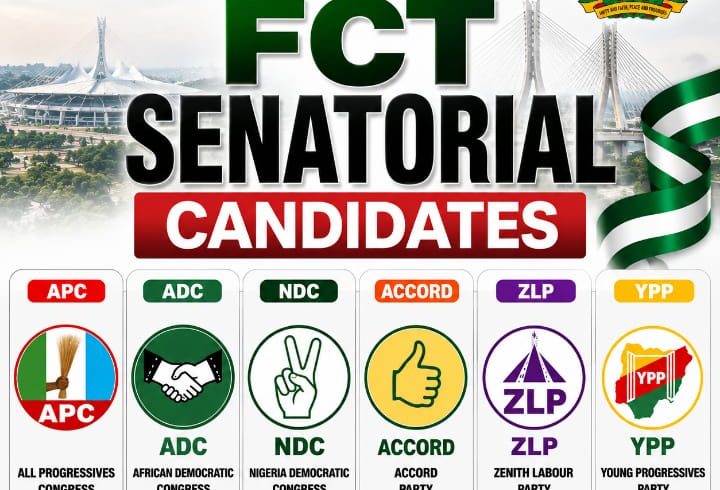

As political activities begin to gather momentum ahead of the 2027 general election, one question deserves serious attention in the Federal Capital Territory: who will become the FCT Senator who will speak for the indigenous people of Abuja at the National Assembly?

The Federal Capital Territory occupies a unique position in Nigeria’s political architecture. It is the nation’s capital, yet it does not enjoy the same constitutional political structure as the 36 states. There is no elected governor and no state House of Assembly. Instead, the FCT is administered directly by the Federal Government.
This peculiar arrangement has created a representation gap that must not be ignored.

For decades, the Gbagyi and other indigenous communities of the FCT have watched their ancestral lands transformed into Nigeria’s capital city. Roads, districts, estates, government institutions and commercial centres have emerged on lands that once belonged to indigenous communities.
Yet, for many of the original inhabitants, the benefits of this transformation have not always been proportional to the value of what was lost.
Land has been acquired. Communities have been displaced. Some indigenous families have been pushed further into the suburbs and satellite communities, while the city built on their ancestral land continues to expand.
You may Like:
This is not an argument against development.
It is an argument for inclusion and fairness.
The indigenous people of the FCT should not become spectators in the political and economic development of their own ancestral homeland.
This is why the coming Senate election should be about more than political parties and personalities. It should be about representation.
The FCT needs a senator who understands the peculiar challenges of the indigenous population and is prepared to take those issues to the National Assembly.
The question should be simple: who will champion the interests of the people whose ancestral lands became the Federal Capital?
Such representation should include serious advocacy for better educational opportunities for indigenous children, employment opportunities, skills development, infrastructure and meaningful participation in government.
An average Gbagyi child should not have to watch outsiders take advantage of opportunities in the capital while his or her family struggles on the outskirts of the very city built on their ancestral land.
Education must be central to this conversation.
Rather than simply talking about political appointments, there should be a deliberate push for scholarship programmes, improved schools, vocational training and other interventions that can give indigenous children the capacity to compete for opportunities within the FCT and across the country.
Employment is equally important.
There should be stronger advocacy for indigenous participation in the workforce of the Federal Capital Territory Administration and in relevant federal institutions operating within the territory.
But there is an even bigger political question.
Can an indigenous son or daughter of the FCT eventually become Minister of the Federal Capital Territory?
There is nothing inherently impossible about such an ambition. If the FCT is truly a federal territory belonging to all Nigerians, then its indigenous people should not be permanently excluded from occupying the highest political office responsible for administering their ancestral homeland.
The Minister of the FCT exercises responsibilities comparable in many respects to those performed by governors in the states. It would therefore be a powerful symbol of inclusion if, one day, an indigene of Abuja could occupy that office.
But that possibility will remain distant if indigenous communities are politically fragmented, poorly represented and absent from the structures where decisions are made.
This is why political participation matters.
The Gbagyi people cannot afford to remain politically passive while decisions about their land, future and opportunities are made by others.
They must participate.
They must organise.
They must vote.
Follow us on Facebook for timely updates.
And, most importantly, they must demand accountability from whoever seeks to represent them.
The incoming FCT senator should therefore understand that representation is not merely about attending Senate sittings or sponsoring occasional motions. It is about having a clear agenda for the people.
The senator should be prepared to push for policies that address compensation for displaced communities, access to education, employment, infrastructure, land rights and greater inclusion of indigenous people in the administration of the FCT.
Where necessary, legislation should be introduced or supported to address these concerns.
But this must also be done within the framework of Nigeria’s Constitution and existing laws. The demand should not be for privileges that exclude other Nigerians, but for genuine equity that recognises the unique circumstances of the people whose ancestral lands became the Federal Capital.
The FCT belongs to every Nigerian. But that national ownership should not erase the history, identity and legitimate interests of its indigenous communities.
The 2027 Senate election therefore presents an opportunity.
The people of the FCT should ask every candidate a straightforward question:
What will you do for the indigenous people of Abuja?
Not what party are you contesting under.
Not how much money can you spend.
Not how many political connections do you have.
But what is your plan for education, employment, land issues, infrastructure and political inclusion?
The next senator representing the FCT should be someone capable of taking these questions from the communities of Abuja to the chambers of the National Assembly.
Because Abuja is not merely a capital city.
It is also the ancestral home of people who have made enormous sacrifices for Nigeria’s capital project.
They deserve representation that recognises that history.
They deserve a voice.
And they deserve a senator who will use that voice.